

Risk/Reward Analysis for Cash-Secured Put Stocks
Assess cash-secured puts by measuring return-on-risk, breakeven, and assignment odds; weigh manual analysis versus automated AI tools.
Selling cash-secured puts vs. covered calls is a common debate, but the former is a simple options strategy that generates income upfront by collecting premiums. You agree to buy 100 shares of a stock at a set price (strike) if assigned, and you keep the premium regardless of the stock's performance. If the stock stays above the strike, the option expires worthless, and you pocket the premium. If it drops below, you buy the shares at the agreed price.
The key to success lies in balancing risk and reward. Higher premiums often mean higher risk due to factors like volatility or weak fundamentals. To manage this, calculate metrics like return on risk, annualized yield, and breakeven price. Choose stocks you'd be comfortable owning long-term, avoid risky categories, and limit each position to 2-5% of your portfolio.
For those who prefer automation, platforms like ThetaEdge simplify the process by calculating risks, returns, and probabilities, while providing AI-driven insights tailored to your portfolio. It saves time but comes with a cost ($83.25/month billed annually). Manual analysis offers more control but requires significant effort and is prone to errors.
Bottom line: Whether you prefer manual analysis or automated tools like ThetaEdge depends on your time, experience, and portfolio management style.
1. Manual Cash-Secured Put Analysis
Risk/Reward Metrics
To evaluate the potential of a cash-secured put, start by calculating the Return on Risk. This is done by dividing the total premium collected by the cash required to secure the position (strike price × 100). This gives you the immediate yield on your locked capital. To compare trades with different time frames, calculate the Annualized Return by multiplying the Return on Risk by (365 ÷) Days to Expiration.
Your Break-Even Stock Price is the strike price minus the premium per share. This is the price at which you would start incurring a loss if assigned. The maximum profit is limited to the premium collected, while the maximum loss occurs if the stock price drops to zero, calculated as ((Strike Price × 100) - Total Premium). Historical data reveals that the PUT Index, which tracks cash-secured put writing, experienced a maximum drawdown of -32.7% from June 1986 to December 2018, compared to the S&P 500’s -50.9% during the same period.
Stock Selection Tools
Once you’ve quantified the risk and reward, the next step is picking stocks that match these metrics. Focus on stocks you’d be comfortable owning long-term. Examples include Dividend Aristocrats like Coca-Cola (KO), Johnson & Johnson (JNJ), and Procter & Gamble (PG), along with Big Tech names such as Apple (AAPL), Microsoft (MSFT), and Alphabet (GOOGL), or stable financial companies like JPMorgan Chase (JPM) and Bank of America (BAC).
Look for stocks with high liquidity (daily volume exceeding 1 million shares) and options with tight bid-ask spreads (no more than $0.05) to ensure fair pricing. Basic chart analysis can help, too - target stocks trading above key moving averages and choose strike prices near established support levels.
Steer clear of high-risk categories like biotech stocks (due to binary event risks), meme stocks (prone to unpredictable swings), and companies with a history of missing earnings expectations. As the Days to Expiry Trading Team advises:
Never sell a put on a stock you wouldn't be thrilled to own at the strike price. That's it. That's the entire safety net.
Practical Risk Management
After running the numbers and selecting stocks, focus on disciplined risk management. Limit each put position to 2-5% of your portfolio to cushion against unexpected drops. Aim for a delta between 0.15 and 0.30 - a delta of 0.20 offers an 80% statistical probability of success at the outset. Data suggests that a 5% out-of-the-money strike with 30 days to expiration has about a 22% chance of assignment.
Set a 50% profit target by placing a Good Till Canceled buy-to-close order at half the premium collected. This helps secure profits while reducing exposure. Avoid selling puts during earnings announcements or major economic events to sidestep sudden price gaps. Meanwhile, keep your collateral in T-Bills or money market funds. This way, your cash earns a risk-free yield (around 4.5%) while also serving as collateral for your options. This approach blends risk management with efficient use of capital, creating a well-rounded cash-secured put strategy.
sbb-itb-a9ac3c2
2. ThetaEdge Platform
Risk/Reward Metrics
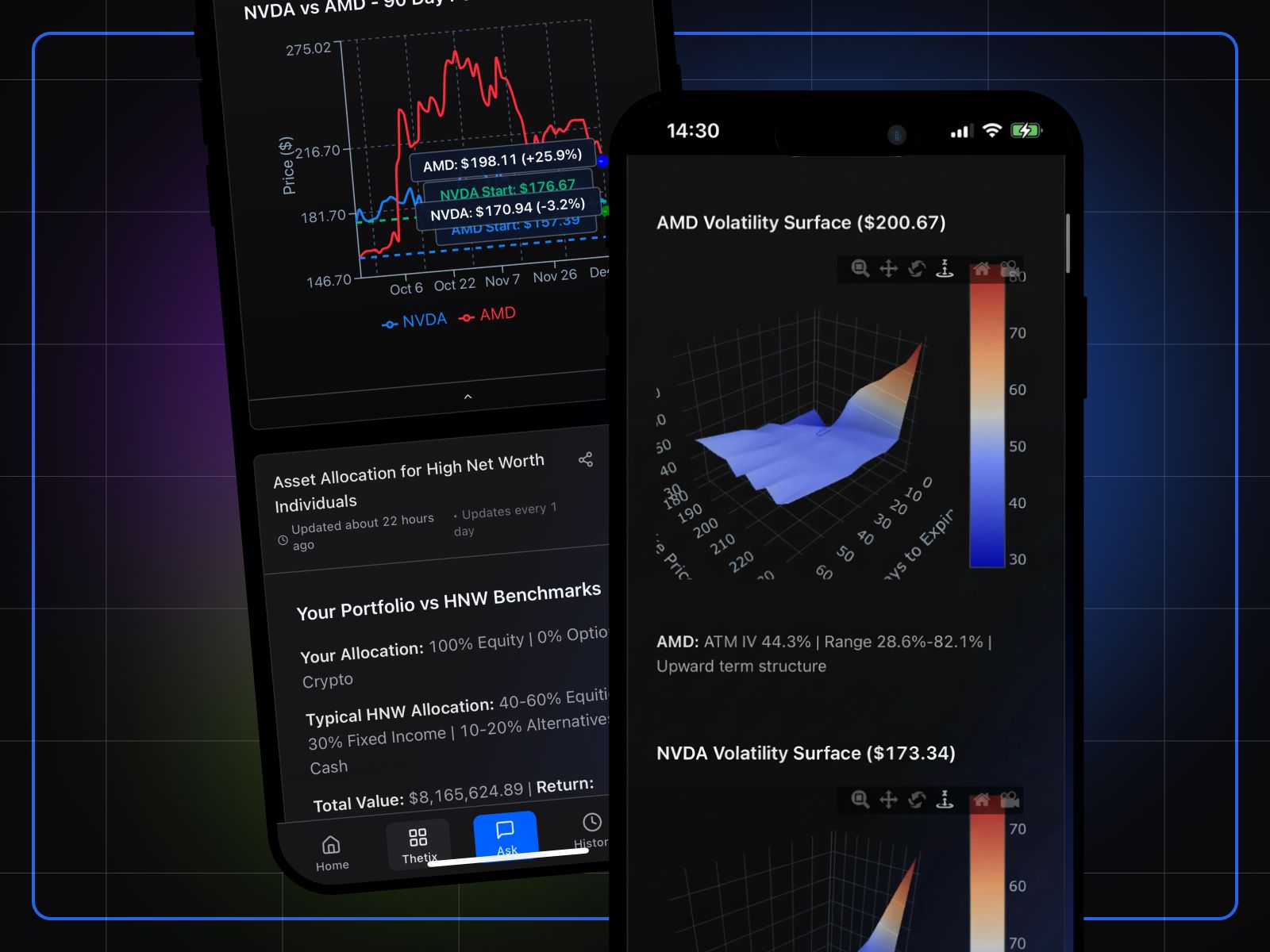
ThetaEdge connects directly with your brokerage to automatically calculate risk and reward metrics for cash-secured put opportunities. Each opportunity is displayed on an Opportunity Card, summarizing key details like strike price, expiration date, premium, assignment probability, and breakeven point. By automating these calculations, ThetaEdge delivers instant, portfolio-specific insights - eliminating the need for manual work. Using live market data, you can even ask its AI assistant, Thetix, plain-English questions about specific positions.
The platform has already analyzed over $26 million in assets, tracked $1.5 million in premiums, and serves members with an average portfolio size of roughly $300,000 [9,11]. With each opportunity, ThetaEdge highlights the downside buffer, helping you weigh potential gains against the risks of assignment [9,11].
This efficiency extends seamlessly into its advanced stock screening tools.
Stock Selection Tools
ThetaEdge takes stock screening to the next level. Instead of relying on traditional equity or options screeners, you can ask Thetix to scan the market for stocks that align with your criteria, factoring in your current holdings and available cash. This builds on manual filtering techniques but saves time and increases precision. As Maxim Khailo, Founder & CEO of ThetaEdge, puts it:
"Instead of using some equity or options screener, ask Thetix to do the hard work for you, save time, and explore new investment and trading ideas in a faster and more powerful way."
Once you identify an opportunity, you can create a Thetix Card to track live updates directly within the chat interface. The platform also supports secure, read-only integration with over 80 brokerages, allowing you to maintain full control over your accounts while benefiting from advanced analysis.
Portfolio Integration
ThetaEdge integrates with your brokerage accounts using secure, read-only access, analyzing your portfolio without executing trades [9,11]. It categorizes opportunities into Income, Growth, and Optimization ideas, helping you align trades with your financial goals while managing positions more effectively. You can also consolidate data from multiple brokerage accounts into one unified view, gaining insights into income, risk, and opportunities across your entire portfolio.
To keep your portfolio balanced, the platform tracks aggregate portfolio Greeks - delta, gamma, theta, and vega - ensuring you don’t overexpose yourself to cash-secured put positions. Reflecting on the platform’s simplicity, Sarah C., Marketing Director, shares:
"I worried I'd have to move all my investments or learn complicated trading tools. But here, I keep my accounts where they are, and everything's explained in plain language."
Practical Risk Management
ThetaEdge goes beyond analysis by offering tools for active risk management. It continuously monitors expirations and includes Roll Management features to evaluate credit/debit trade-offs and update assignment probabilities when positions move against you [9,11]. Targeted alerts keep you informed, and you can set custom risk conditions - like "alert me if volatility spikes above 40%" - to receive notifications when market conditions change.
The platform offers a 30-day free trial, giving you full access to its analytics and AI tools. After the trial, the service is priced at $83.25 per month when billed annually at $999 per year.
Pros and Cons
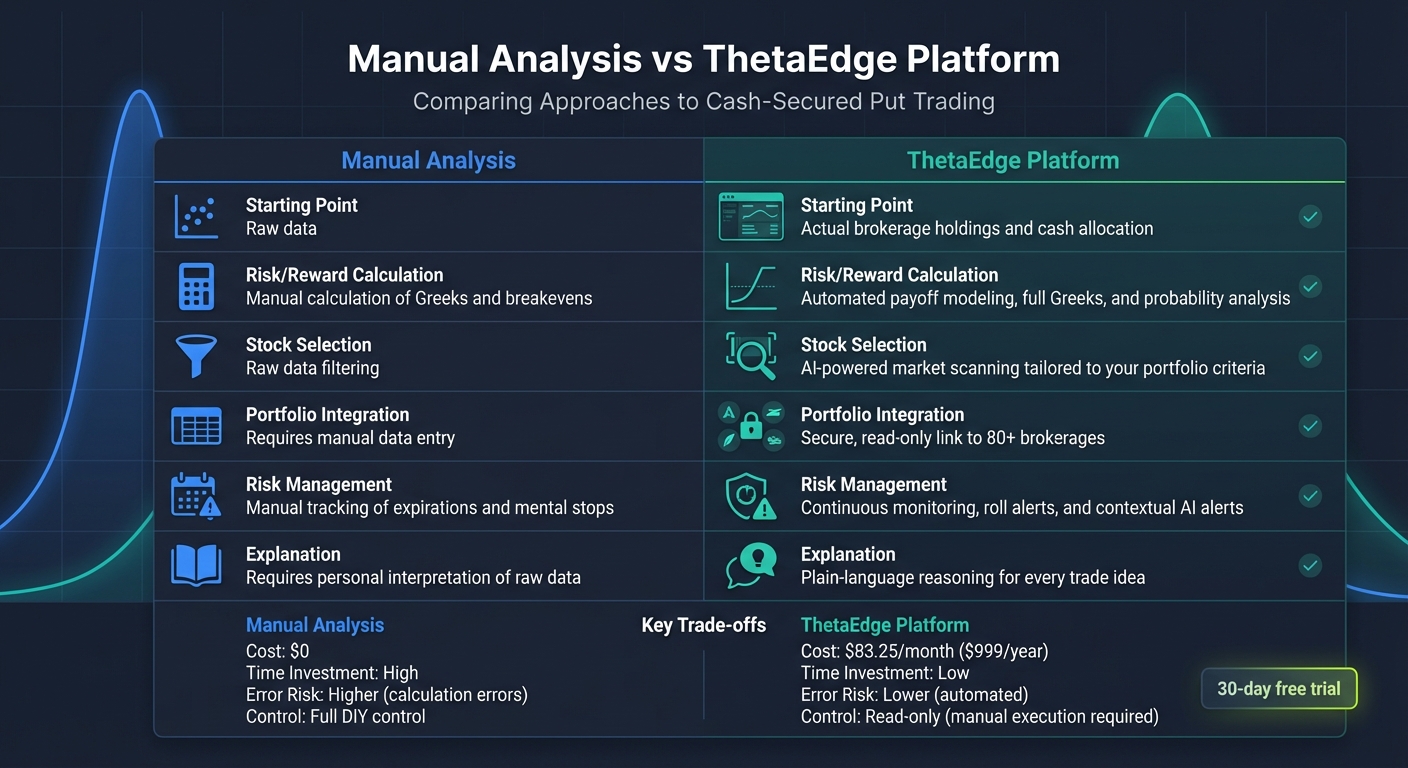
Manual vs ThetaEdge Cash-Secured Put Analysis Comparison
Building on the earlier discussion of risk and reward, as well as stock selection, this section compares the hands-on approach of manual analysis with the streamlined efficiency of automated tools like ThetaEdge.
Manual analysis offers total control but demands significant time and effort. Starting with raw data, you must calculate key metrics such as annualized returns and calculate risk for cash-secured puts by hand. For example, traders often misunderstand short-term returns - a 4% gain over 31 days actually annualizes to 47%. Since market conditions are constantly changing, this static method requires ongoing re-evaluation, which can be both time-consuming and prone to errors.
ThetaEdge, on the other hand, takes a different approach. Instead of relying on generic screeners, it begins with your actual brokerage holdings and cash allocation. The platform automates complex calculations, including Greeks, assignment probabilities, and break-even points, across your entire portfolio. Tasks that would otherwise require advanced tools and hours of work are completed in moments. Additionally, ThetaEdge allows users to scan the market using plain-English queries, delivering ranked opportunities tailored to your portfolio. Its continuous monitoring features, such as roll alerts and lifecycle management, further reduce the need for manual tracking.
Here’s a side-by-side comparison to highlight the differences:
| Feature | Manual Analysis | ThetaEdge |
|---|---|---|
| Starting Point | Raw data | Actual brokerage holdings and cash allocation |
| Risk/Reward | Manual calculation of Greeks and breakevens | Automated payoff modeling, full Greeks, and probability analysis |
| Stock Selection | Raw data filtering | AI-powered market scanning tailored to your portfolio criteria |
| Portfolio Integration | Requires manual data entry | Secure, read-only link to 80+ brokerages |
| Risk Management | Manual tracking of expirations and mental stops | Continuous monitoring, roll alerts, and contextual AI alerts |
| Explanation | Requires personal interpretation of raw data | Plain-language reasoning for every trade idea |
The choice boils down to trade-offs. Manual analysis doesn’t involve subscription fees but requires constant effort and carries a greater risk of calculation errors. In contrast, ThetaEdge costs $83.25 per month (billed annually at $999) after a 30-day free trial. While this comes with a price tag, it saves time and helps avoid missed opportunities for premium income. As ThetaEdge puts it, "Every month without a systematic approach is premium income left on the table."
That said, ThetaEdge does have its limits. It’s a read-only service, meaning you still need to execute trades manually through your brokerage. This setup keeps you in control but requires hands-on execution. For traders who value their time and want professional-grade insights without building custom spreadsheets, ThetaEdge offers a practical solution. However, for those who prefer full DIY control and have the time to dedicate, manual analysis remains an option - though it comes with a heavier workload and a higher chance of human error.
Ultimately, whether you choose manual analysis or an automated tool like ThetaEdge depends on your priorities, time availability, and how you prefer to balance control with efficiency.
Conclusion
Deciding between manual analysis and using ThetaEdge largely depends on your level of experience and how much time you can dedicate to managing your trades.
Manual analysis is a great starting point for beginners. It helps you build a strong understanding of the basics while keeping costs at zero. However, it does require staying on top of things like earnings dates, ex-dividend schedules, and technical levels. The downside? It can be time-consuming and leaves room for calculation errors.
For those with more experience or larger portfolios, automation becomes a game-changer. ThetaEdge simplifies the process by automating critical risk and reward metrics, which is a huge advantage when managing multiple positions. At $83.25 per month (billed annually at $999), it’s designed to help you capture premium income that might otherwise slip through the cracks - especially in volatile markets where opportunities can disappear quickly.
Beginners can gain valuable insights through manual methods, but advanced traders will appreciate how ThetaEdge streamlines their workflow. Its AI-powered scanning and real-time alerts save hours of effort, replacing spreadsheets with precision and speed.
Both options are effective for analyzing risk and reward in cash-secured put strategies. Manual analysis gives you full control at no cost, while ThetaEdge provides efficiency and scalability. The best choice depends on your trading goals and how you prefer to manage your time and risk.
FAQs
How do I pick a strike and expiration for a cash-secured put?
When deciding on a strike price and expiration, it's important to align them with your risk tolerance and market expectations. A good starting point for the strike price is near key support levels or areas where the stock seems reasonably priced. Aim for a delta between 0.15 and 0.30 - this range strikes a balance between generating income and managing risk.
For expiration dates, shorter durations, typically around 30 days, provide more flexibility and allow you to adjust to changing market conditions. On the other hand, longer durations can yield higher premiums but come with extended exposure to market fluctuations. The key is to choose both the strike and expiration in a way that supports your financial objectives and comfort with risk.
When should I close early or roll a cash-secured put?
If the stock price dips below your strike, you might want to either close the position early or roll the cash-secured put. This can help you avoid assignment or reduce potential losses. Rolling is particularly useful when the option is close to expiration, especially if market conditions have introduced additional risk.
On the other hand, if you're okay with owning the stock at a lower price, taking assignment could align with your goals. However, if the trade no longer matches your strategy, closing early is always a reasonable choice.
How do I size cash-secured puts across my portfolio to limit drawdowns?
To keep drawdowns in check, consider allocating funds to cash-secured puts in proportion to your portfolio size and comfort with risk. Spread your investments across different sectors and strike prices to avoid putting too much weight on any single area. Opt for shorter expiration cycles to better manage your exposure, and establish clear exit rules - like closing a position if losses reach a predetermined level. Together, these approaches can help you manage risk and limit potential losses in your portfolio.