

10 Best Stocks for Covered Calls in 2026
Top 10 liquid, dividend-friendly stocks for covered-call strategies in 2026, with volatility profiles, dividend yields, and option timing tips.
Covered calls are a popular strategy for generating income by holding stocks and selling call options instead of cash-secured puts. The key is choosing stocks with high liquidity, moderate volatility (30%-70%), strong fundamentals, and dividend yields above 2%. This approach can boost annual returns by 3.6% and reduce monthly volatility by 20%.
Here are 10 stocks well-suited for covered calls in 2026:
- Apple (AAPL): Low volatility (±32.2%), strong liquidity, 0.38% dividend yield.
- Microsoft (MSFT): Moderate volatility (±26.4%), high liquidity, 0.77% dividend yield.
- Coca-Cola (KO): Low volatility (±18%), stable income, 2.86% dividend yield.
- AMD: High volatility (±44.1%), no dividend, highest premium potential.
- Lowe’s (LOW): Balanced volatility, ~2% dividend yield.
- Ford (F): Above-average volatility, affordable, 4% dividend yield.
- Wells Fargo (WFC): Moderate volatility (±31.3%), 2.37% dividend yield.
- Pfizer (PFE): Low volatility (±24.8%), high dividend yield (6.75%).
- Exxon Mobil (XOM): Moderate volatility, 3.57% dividend yield.
- ConocoPhillips (COP): Moderate volatility, 4.8% dividend yield.
For success, focus on options with expirations of 30-45 days, delta between 0.2 and 0.4, and strike prices slightly above the market value. Pairing this strategy with tools like ThetaEdge, which uses AI to analyze market conditions, can help optimize timing and maximize income while managing risks. Before entering a trade, review a covered call checklist to ensure all criteria are met.
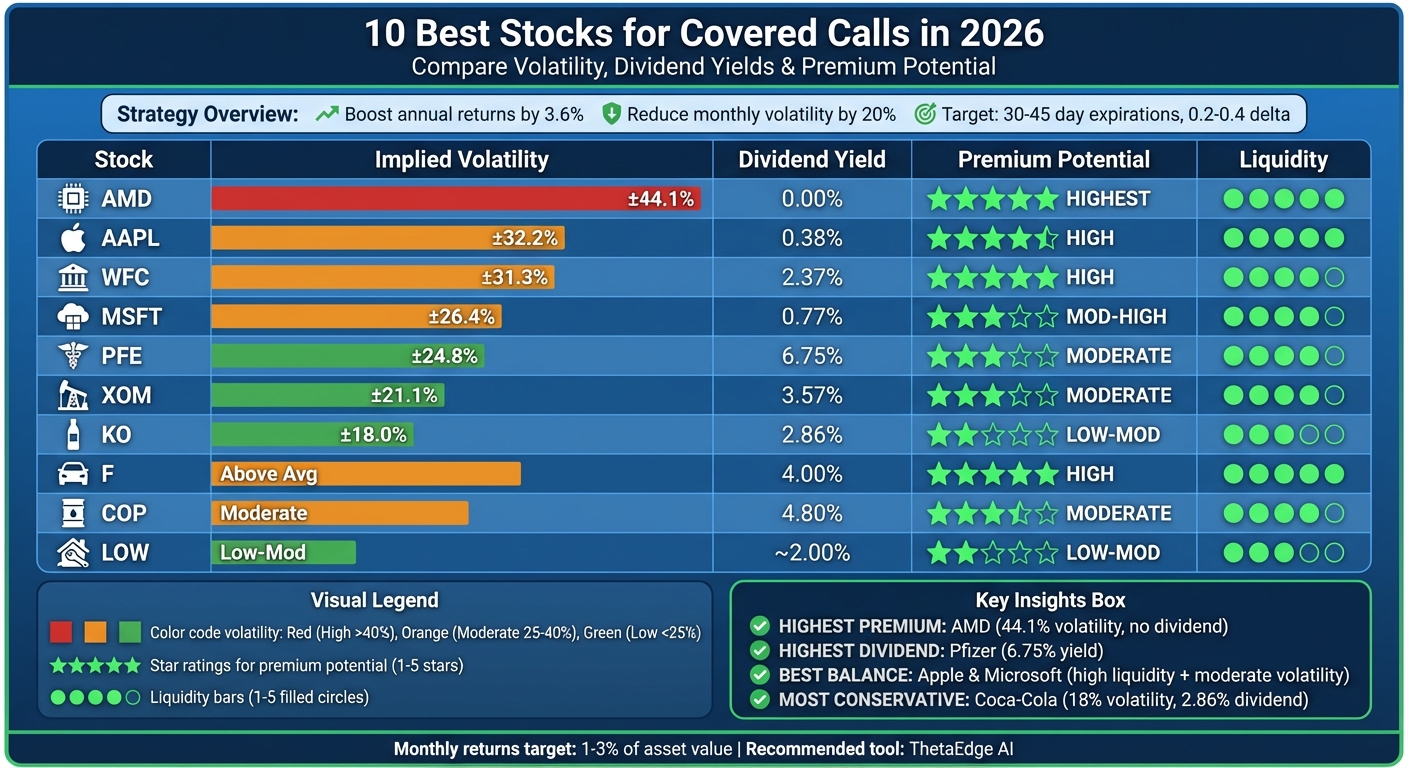
10 Best Covered Call Stocks 2026: Volatility, Dividends & Premium Potential Comparison
sbb-itb-a9ac3c2
How We Selected These 10 Stocks
When choosing stocks for covered calls, we aimed to strike a balance between generating income and managing risk. Our process focused on several key factors to ensure steady premium income without exposing your portfolio to unnecessary volatility.
Options liquidity was the first consideration. All the stocks on this list have highly active options markets with tight bid-ask spreads and significant daily trading volumes. For example, Apple and Microsoft are among the most actively traded options globally. Liquidity is essential because tighter spreads lower transaction costs and make it easier to execute trades at fair market value. As LevelFields AI explains:
The best stocks for covered calls share three traits: Liquid option chains, manageable volatility, and no imminent bullish catalyst.
Liquidity serves as the foundation for evaluating each stock's volatility profile.
We focused on stocks with a beta range of 0.30 to 1.06 and a delta between 0.20 and 0.40. This combination helps secure attractive premiums while keeping assignment risk under control. For example, Pfizer, with a beta of 0.32 and a dividend yield of 6.75%, serves as a defensive option. On the other hand, AMD, which has a beta of 1.00, offers higher premiums but comes with more event-driven risk.
Financial health was another critical factor. Each company on the list demonstrates stable cash flow, manageable debt, and consistent earnings - qualities that make them reliable for long-term ownership while collecting premiums. For instance, Wells Fargo, with a P/E ratio of 15.2 and a beta of 0.61, offers moderate volatility, while Exxon Mobil stands out for its strong cash flow and steady dividend growth, yielding 3.57%. These financial strengths add stability to the strategy.
Lastly, dividend income provides an additional revenue stream. Many of the selected stocks offer yields above the market average of 2%, such as Ford at nearly 4.00% and ConocoPhillips at 4.80%. This dual-income strategy - earning both option premiums and dividends - can deliver monthly returns of 1% to 3% of the underlying asset's value.
1. Apple (AAPL)
Apple stands out as a strong choice for covered call strategies, thanks to its highly liquid options market and steady market performance. With a market cap of $3.2 trillion and a beta of 0.54, Apple offers long-term stability and reduced risk of sudden price fluctuations. These qualities align well with the key factors of liquidity, controlled volatility, and financial strength.
Implied Volatility
Apple's implied volatility sits at ±32.2%, striking a balance between attractive premiums and manageable price movements. This moderate level of volatility makes it suitable for selling calls without exposing investors to the risks tied to more volatile stocks. Its P/E ratio of 27.1 further reflects a premium valuation, supported by the company's steady performance.
Option Premium Yield
Apple's options market is known for its tight bid-ask spreads, making it easier for investors to execute trades efficiently. Selling monthly covered calls during quieter periods - avoiding earnings announcements or buyback news - can help capture premiums while minimizing the chance of missing out on sudden price rallies. Aiming for options with a delta between 0.2 and 0.4 provides a good mix of premium income and manageable assignment risk. This approach makes Apple a reliable candidate for a consistent covered call strategy.
2026 Dividend Yield
Apple's dividend yield of 0.38% adds a steady income stream to the premiums earned from selling calls. Frequent share buybacks by the company also create a stable environment, making it easier to time call sales effectively.
2. Microsoft (MSFT)
Microsoft stands out with a market cap of $3.35 trillion and a beta of 0.51, reflecting its strong fundamentals and relatively low volatility. The company's leadership in AI and cloud computing continues to fuel its revenue growth, offering opportunities for both capital appreciation and steady option income.
Implied Volatility
Microsoft's implied volatility is around ±26.4%, with an IV Rank of 32.14%. This places its volatility in the lower third of its annual range. The stock's P/E ratio stands at 38.2, making it a solid candidate for premium-generating strategies.
Option Premium Yield
Microsoft's options market benefits from excellent liquidity and narrow bid-ask spreads, making it attractive for income-focused strategies. A covered call strategy on MSFT has historically delivered annualized returns of about 12.12%, easily surpassing the S&P 500's average dividend yield of 1.51%. As Gavin McMaster, who holds a Masters in Applied Finance and Investment, explains:
Covered calls are a fantastic way to generate extra income from a stock holding while also providing some downside protection.
Additionally, the stock's 28% price movement over a six-month period leading into 2026 has offered the momentum needed to secure appealing premiums while maintaining stability.
2026 Dividend Yield
Microsoft's dividend further enhances its income potential. With a dividend yield ranging from 0.70% to 1.0%, the most recent figure at 0.77%, it creates a secondary income stream when paired with option premiums. The next ex-dividend date is set for February 19, 2026. Timing call option sales during quieter periods - avoiding earnings announcements and other major news - can help maximize premium income while reducing the risk of shares being called away during sudden price surges.
3. Coca-Cola (KO)

Coca-Cola has long been viewed as a reliable choice for steady income and stability. With a market cap of $316.2 billion and a beta ranging from 0.07 to 0.19, the stock moves largely independent of broader market fluctuations. This makes it a solid option for preserving capital while generating premium income. Holding a commanding 40% share of the global non-alcoholic beverage market and maintaining a 31% operating margin, Coca-Cola continues to demonstrate its strength.
Implied Volatility
Coca-Cola's strong fundamentals align with its relatively low stock volatility, making it ideal for conservative premium strategies. As of late January 2026, the stock's 12-month price volatility is approximately 18%. This lower volatility translates to smaller but more predictable premiums, reducing the likelihood of assignment risk.
Option Premium Yield
Despite its conservative nature, Coca-Cola still delivers attractive annualized returns through covered-call strategies. Recent trades have shown yields ranging from 6.4% to 15.67%. For example, a February 21 call at a $65 strike price traded at $1.35, producing a 10.96% yield, while a December 18 call at a $72.50 strike generated a 6.4% yield. As Gavin McMaster, Founder of Options Trading IQ, highlights:
Coca-Cola is a low beta stock that pays a 3% dividend. But we can significantly increase that yield by trading a long-term covered call strategy.
2026 Dividend Yield
Coca-Cola's status as a Dividend King, with over 60 years of consistent dividend increases, adds another layer of appeal. Its dividend yield, ranging from 2.7% to 3.1%, complements the income generated by covered-call strategies. Combined, these elements can push total annualized returns to 8–12% before factoring in any capital appreciation. As Investor's Business Daily puts it:
For income-focused investors, covered calls offer an additional way to boost Coke stock's already appealing dividend yield.
The high liquidity in Coca-Cola's options market ensures tight bid-ask spreads, making it easier to enter and exit positions with minimal slippage. As of January 29, 2026, Coca-Cola shares were trading at $73.49.
4. Advanced Micro Devices (AMD)

Advanced Micro Devices (AMD) presents a high-volatility option for those employing covered-call strategies. With an estimated volatility of ±44.1% and a Beta of 1.00, AMD's price movements generally align with broader market trends. Unlike conservative dividend stocks, AMD offers larger option premiums, which appeals to investors aiming to maximize premium income.
Implied Volatility
AMD's elevated volatility translates to higher premiums but comes with a greater risk of assignment. The stock's performance is heavily influenced by events like product launches and earnings reports, which can cause sharp price swings. As LevelFields AI explains:
AMD is highly event-driven. Product launches and earnings shifts can change outcomes quickly.
Timing plays a crucial role here. Selling shorter-duration calls during periods without major announcements can help capture the elevated premiums while reducing the chance of missing out on significant price rallies. This strategy leverages AMD's volatility to enhance premium yield potential.
Option Premium Yield
Since AMD doesn't pay a dividend, all income from covered-call strategies depends on option premiums and potential capital gains. The stock's high-volatility environment allows for the possibility of higher annualized yields compared to more stable blue-chip stocks. To strike a balance between income and retaining shares during AMD's rapid price movements, it's advisable to select strikes that are further out-of-the-money.
Average Volume
AMD's options market is highly liquid, with tight bid-ask spreads. This liquidity ensures that investors can make quick adjustments to their positions, even during volatile periods.
5. Lowe's Companies (LOW)
Lowe's Companies hits a sweet spot for covered-call strategies, striking a balance between stability and opportunity. Positioned between the defensive and cyclical sectors, LOW offers solid option pricing without the wild swings typically seen in high-growth tech stocks. This makes it a strong candidate for collecting consistent premiums while keeping risk at a reasonable level. Let’s dive into the key metrics that make LOW a great fit for this strategy.
Implied Volatility
LOW's implied volatility tends to fluctuate around retail earnings reports and sector updates. The best time to sell calls is after earnings-related volatility settles down. This timing allows for more predictable price movements, helping investors lock in stable premiums while minimizing the risk of earnings-driven price spikes. Unlike high-volatility stocks that offer larger but riskier premiums, LOW provides a more balanced approach, combining manageable risk with steady income potential.
Option Premium Yield
As a cyclical stock, LOW often delivers higher option premium yields compared to more defensive names, while still maintaining a level of predictability. Covered-call investors can typically expect monthly yields of 1% to 1.5% from option premiums. Pair this with LOW's consistent dividend payouts, and you’ve got a reliable dual income stream.
Average Volume
LOW's option chains are highly liquid, featuring tight bid-ask spreads - an essential feature for efficient covered-call execution. This liquidity ensures smooth entry and exit points, as well as easy rolling of positions when adjustments are needed. Backed by its strong financials and leading market position, LOW provides a stable foundation for premium collection.
2026 Dividend Yield
LOW's dividends add another layer of stability, helping to offset potential losses in case of a price decline. Keep an eye on bullish developments, like dividend hikes or share buybacks, as these can sometimes trigger early assignment of shares.
6. Ford Motor Company (F)

Ford Motor Company stands out as a straightforward choice for implementing covered-call strategies. With its stock trading at $14.00 as of January 29, 2026, the low share price makes it easier for investors to purchase the standard 100-share lots required for writing covered calls without needing to commit a large amount of capital. Additionally, Ford's combination of a lower price point and higher-than-average implied volatility makes it a solid pick for income-focused strategies.
Implied Volatility
As of January 29, 2026, Ford's implied volatility is at 41.33%, with an IV Rank of 34.52%. This places it in the lower-middle range of its one-year volatility history. Higher implied volatility translates to more attractive option premiums, but timing matters. With Ford's next earnings report scheduled for February 10, 2026, it's wise to avoid selling narrow strike calls right before this date. Doing so reduces the risk of shares being called away during a potential post-earnings rally.
Option Premium Yield
Ford's volatility allows investors to aim for monthly returns of around 1% to 1.5% by selling calls. To strike a balance between income generation and risk management, focus on selling calls nearly 10% out-of-the-money with expirations set 30–45 days out. This approach captures a consistent period of time decay while leaving a reasonable margin to avoid assignment. Ford's highly liquid options market ensures tight bid-ask spreads, making it easier to manage positions efficiently.
2026 Dividend Yield
Ford also offers a dividend yield of about 4%, providing an additional income source for those using covered-call strategies. Its quarterly dividend of $0.15 per share adds a layer of downside protection. To maximize returns, time your call sales to avoid the ex-dividend date and steer clear of deep in-the-money strikes, which could lead to early exercise as investors seek to capture the dividend.
7. Wells Fargo (WFC)
Wells Fargo stands out for its combination of stability, liquidity, and moderate volatility - qualities that make it a solid choice for generating consistent income through covered calls. As a diversified financial institution, it offers steady price movements, minimizing the risk of unexpected assignments. With the added benefit of dividend payments alongside option premiums, this stock appeals to investors aiming for reliable returns. These factors align well with the criteria for selecting strong covered-call opportunities.
Implied Volatility
Wells Fargo's implied volatility sits at around 27.93%, with a 12-month range spanning from 17.50% to 37.51%. By early 2026, the stock's overall volatility is projected to hover near ±31.3%. This moderate volatility strikes a balance - it’s high enough to offer attractive premiums but stable enough to limit the chances of shares being called away during normal market fluctuations. Traders typically aim to sell calls when volatility is in the 30–35% range, steering clear of narrow spreads around earnings announcements or dividend increases.
Option Premium Yield
Strong liquidity and stable volatility enable Wells Fargo to deliver impressive premium yields. For instance, selling a monthly at-the-money call could generate approximately 1.74% income over 34 days, translating into an annualized yield of about 18.65%. For those seeking a less hands-on strategy, a six-month covered call might provide an annualized yield of roughly 14.61%. To balance income potential with growth opportunities, choosing strike prices about 10% out-of-the-money and opting for expirations in the 30–45 day range works well.
2026 Dividend Yield
As of January 2026, Wells Fargo offers an annualized dividend yield of 2.37%. When combined with premiums from a six-month covered call, the total annualized yield can climb to around 16.98%. To reduce the risk of early assignments, it’s best to time option expirations after the ex-dividend date and avoid deep in-the-money strikes.
8. Pfizer (PFE)
Pfizer offers a blend of stability and income potential, making it a strong candidate for covered-call investors focused on generating consistent returns in 2026. With a beta of just 0.32, the stock is significantly less volatile than the broader market, moving about 68% less, which provides a buffer during market downturns. Recent price declines have pushed Pfizer's dividend yield to an impressive range of 6.75% to 8%. This combination of dividend income and option premiums creates a reliable cash flow, even in challenging market conditions. Let’s look at how Pfizer’s volatility plays into these attractive premiums.
Implied Volatility
As of late January 2026, Pfizer's implied volatility is 25.82%, with a 12-month range spanning 18.44% to 33.73%. This moderate volatility level allows the stock to offer appealing option premiums without exposing investors to excessive risks of early assignment. Factors like developments in Pfizer’s drug pipeline and concerns over corporate debt have contributed to increased volatility, which in turn boosts premiums. Compared to more speculative biotech stocks, Pfizer remains a safer choice while still providing competitive premiums relative to other large-cap pharmaceutical companies. This balance makes it an attractive option for income-focused strategies that prioritize stability.
Option Premium Yield
Pfizer’s strong liquidity and manageable volatility make it an excellent candidate for generating robust option premium yields. For instance, selling a monthly call with a 46-day expiration can yield an annualized return of about 13.18%. Longer-term strategies, such as selling seven-month calls, offer an annualized yield of around 10.87%. For example, a June $29 strike call is priced at $0.46 per contract when the stock trades near $28.16, while a December $29 strike call is priced at $1.79. When combined with Pfizer’s dividend yield, these premiums can push total annualized income into the 15–20% range, assuming the stock price remains stable.
2026 Dividend Yield
Pfizer’s high dividend yield is a key component of its appeal, adding stability to overall returns. This income stream helps cushion against potential price declines and, when paired with call premiums, creates a dual-income strategy. To optimize returns and minimize the risk of early assignment, investors might aim for strike prices slightly above the current market price and stick to 30–45-day expirations. Aligning option expirations with the ex-dividend date can also reduce the likelihood of early assignments on deep in-the-money options. This approach ensures a steady flow of income while maintaining the defensive characteristics that covered-call investors value.
9. Exxon Mobil (XOM)
Exxon Mobil stands out as a stock with defensive qualities, offering a 5.4% dividend yield alongside attractive option premiums. As of January 29, 2026, the stock trades at $140.51, with analyst Gleb Kabanov highlighting its consistent dividend growth fueled by strong production and refining operations. Its reliable cash flows support a dual-income strategy, making it an appealing choice during fluctuating commodity cycles.
Now, let’s dive into Exxon Mobil’s volatility, which plays a key role in generating premium income.
Implied Volatility
Exxon Mobil’s volatility profile makes it particularly suitable for covered call strategies. As of late January 2026, the stock's at-the-money implied volatility stands at 53.00%, significantly higher than its 30-day historical volatility of 24.97%. With an IV Rank of 28.28%, the current volatility suggests potential for premium growth, especially during periods of market uncertainty. The upcoming earnings report on January 30, 2026, is likely to cause a volatility spike, creating opportunities to secure higher premiums.
This favorable volatility backdrop enhances the stock’s potential in the options market.
Option Premium Yield
Exxon Mobil’s elevated volatility and liquid options market make it possible to target monthly premiums of 1%–1.5%, translating to an annualized return of 12%–18% when combined with its dividend yield. To balance premium collection with reduced assignment risk, consider selecting strikes that are 10%–15% out-of-the-money. Additionally, the stock’s deep options market ensures tight bid-ask spreads, allowing for efficient trades with minimal transaction costs.
These premiums work hand-in-hand with the stock’s high dividend yield to provide a steady income stream.
2026 Dividend Yield
Exxon Mobil’s dividend yield, well above the market average of around 2%, offers a solid income cushion for covered-call strategies, even during periods when premium opportunities are limited. However, be cautious of early assignment risks around ex-dividend dates. If a short call is in-the-money and the dividend exceeds the option’s remaining time value, early assignment may occur. To minimize this risk, choose option expirations that occur after the ex-dividend date and avoid deep in-the-money strikes. This approach ensures you can capture both the dividend and the premium.
Exxon Mobil’s combination of high dividends, favorable volatility, and strong option premiums makes it a compelling choice for income-focused investors.
10. ConocoPhillips (COP)
ConocoPhillips closes out this list with a mix of moderate stock volatility and solid cash flow, making it a strong candidate for covered-call strategies. By late 2025, the stock was trading at approximately $95.73. Analyst Mark R. Hake, CFA, highlighted its strong free cash flow and solid balance sheet, which offer a layer of security for investors. On top of that, its 4.8% dividend yield provides an additional income stream, making it particularly appealing in flat or slightly bullish markets.
Implied Volatility
The energy sector's fluctuating oil and natural gas prices contribute to ConocoPhillips' elevated implied volatility. This volatility leads to higher option premiums compared to more stable, low-volatility stocks. Strike prices set 10%–15% out-of-the-money often deliver strong yields. Additionally, the company's options market benefits from high liquidity, which ensures narrow bid-ask spreads, making it easier to manage positions.
"ConocoPhillips' stock usually shows moderate volatility, which allows you to capture favorable option premiums without excessive risk." - VectorVest
This balance of moderate volatility and attractive premiums makes it a compelling choice for option strategies.
Option Premium Yield
With ConocoPhillips, covered calls can often generate monthly returns of 1% to 3% of the stock's value. For example, in July 2025, when the stock was priced at $95.73, a covered call with a $92.50 strike price offered a $1.97 premium. This translated into an immediate yield of 2.13% and a breakeven point 5% below the stock's price. For the best results, focus on options with expirations of 30–45 days and a delta between 0.2 and 0.4.
2026 Dividend Yield
ConocoPhillips' dividend yield of 4.8% is significantly higher than the market average of around 2%, providing a steady income stream even during periods when option premiums are less attractive. This dual-income approach is backed by strong financials. In a recent fiscal period, the company generated nearly $4 billion in operating cash flow and returned $1.4 billion to shareholders through dividends.
How ThetaEdge Helps with Covered Call Analysis
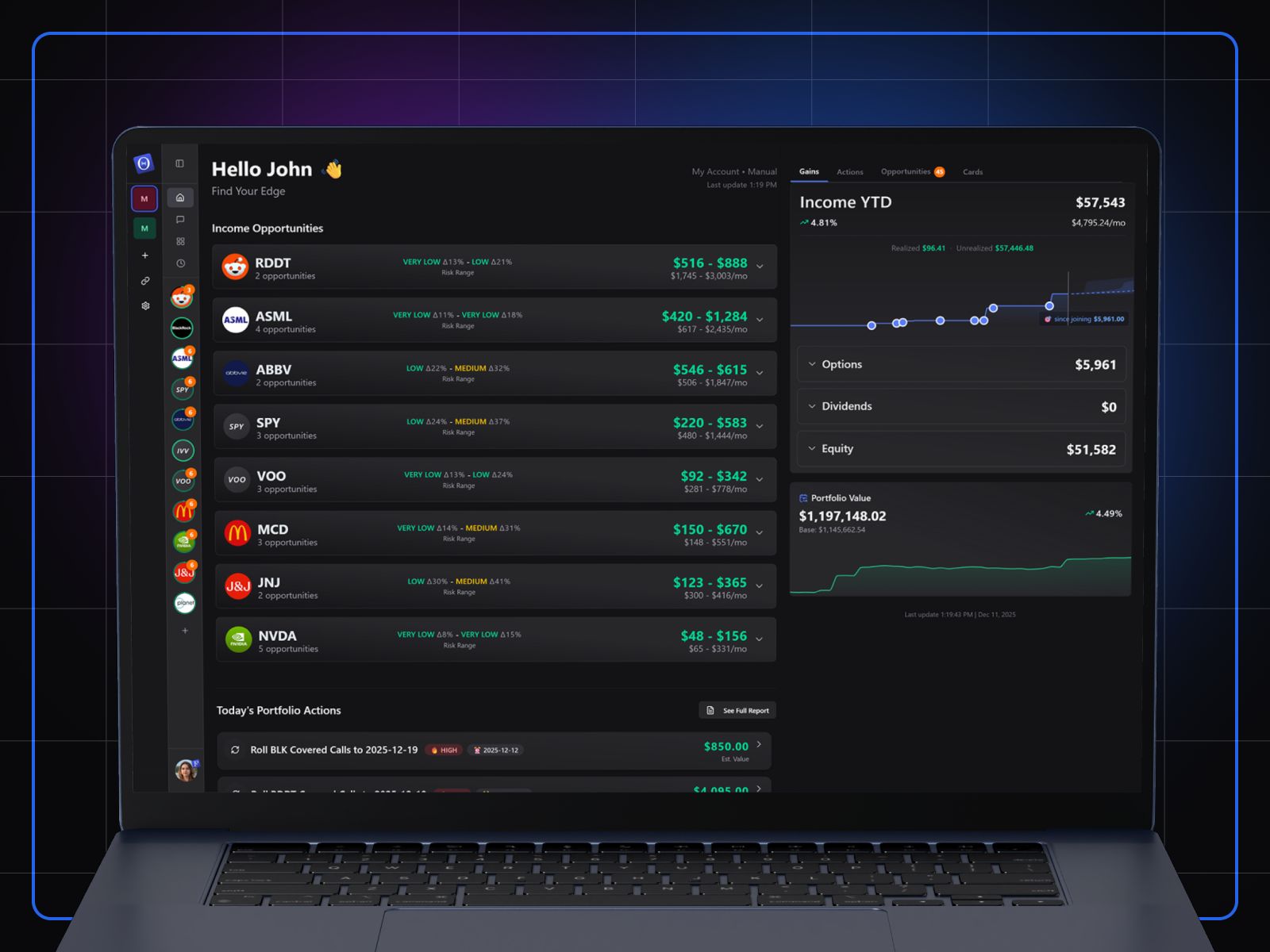
ThetaEdge takes the guesswork out of covered-call strategies by scanning thousands of stocks to uncover the best opportunities for your portfolio. This advanced trading platform leverages AI to monitor over 6,300 U.S. stocks 24/7, identifying market events that could impact your trades. Beyond spotting opportunities, it helps fine-tune your trade timing for maximum effectiveness.
Timing is everything in covered calls. Selling calls too early - before a buyback announcement, dividend increase, or an earnings surprise - can limit your potential gains. ThetaEdge’s AI, Thetix, dives into historical price patterns, offering guidance on whether to sell premiums aggressively or adjust strike prices to avoid having your shares called away.
"Covered calls don't fail because the strategy is flawed. They fail because investors sell calls without knowing what's coming next." – LevelFields AI
ThetaEdge options intelligence platform also highlights bearish signals, suggesting adjustments like widening strike prices or delaying trades. Its probability modeling estimates the likelihood of a stock staying below your strike price, helping you focus on trades with the best balance of risk and reward. Additional tools, including an income tracking dashboard and portfolio Greeks, provide insights into performance trends and portfolio exposure.
With seamless integration across 80+ brokerages and daily AI-driven action plans, ThetaEdge simplifies the trading process. These plans pinpoint periods of elevated implied volatility without bullish catalysts - prime conditions for selling premiums. Currently available for a free trial, ThetaEdge equips you with the insights needed to make smarter, more informed decisions.
Stock Comparison Table
The table below highlights key metrics for various stocks, focusing on implied volatility, dividend yield, premium potential, and option liquidity - essential factors for covered-call strategies.
| Stock | Implied Volatility (Est.) | 2026 Dividend Yield | Premium Potential | Average Option Liquidity |
|---|---|---|---|---|
| AMD | ±44.1% | 0.00% | Highest | Very High |
| Apple (AAPL) | ±32.2% | 0.38% | High | Very High |
| Wells Fargo (WFC) | ±31.3% | 1.96% | High | High |
| Microsoft (MSFT) | ±26.4% | 0.70% | Moderate-High | Very High |
| Pfizer (PFE) | ±24.8% | 6.75% | Moderate | High |
| Exxon Mobil (XOM) | ±21.1% | 3.57% | Moderate | High |
| Coca-Cola (KO) | ±16.4% | 2.86% | Low-Moderate | High |
| Ford (F) | Above Average | 4.00% | High | Very High |
| ConocoPhillips (COP) | Moderate | 4.80% | Moderate | High |
| Lowe's (LOW) | Low-Moderate | ~2.00% | Low-Moderate | Moderate-High |
AMD stands out with ±44.1% implied volatility, offering the highest premium potential but no dividend support. For conservative investors, Coca-Cola is a stable choice with ±16.4% volatility and a 2.86% dividend yield.
Pfizer shines as a dual-income option, combining a 6.75% dividend yield with ±24.8% volatility. Similarly, Ford offers above-average volatility paired with a 4.00% dividend, appealing to those looking for both income and growth.
For systematic income strategies, Apple and Microsoft provide strong liquidity and moderate volatility. Meanwhile, ConocoPhillips and Exxon Mobil deliver solid dividends - 4.80% and 3.57%, respectively - with manageable volatility levels.
This table serves as a quick reference for aligning your investment goals with the right stock characteristics.
Conclusion
The success of covered calls hinges on three key factors: solid stock fundamentals, sufficient option liquidity, and a volatility profile that aligns with your income goals. This ties back to the earlier discussion about balancing risk and return. Whether you’re chasing higher premiums with volatile tech names like AMD or preferring the steadiness of dividend payers such as Pfizer or ConocoPhillips, the trick lies in syncing your strategy with your personal risk tolerance and expected returns.
Timing matters more than stock selection. As LevelFields AI aptly puts it:
Covered calls aren't about 'always selling.' They're about selling when history supports it.
For the best results, focus on specific technical parameters: a delta between 0.2 and 0.4, expirations in the 30–45 day range, and slightly out-of-the-money strike prices. This balanced approach can generate monthly returns of 1% to 3% of the underlying asset’s value.
ThetaEdge simplifies this process by offering tools like risk/reward analysis metrics, assignment probabilities, and AI-driven insights. As highlighted, its event-driven analysis helps pinpoint "quiet periods" with no bullish catalysts - ideal times to sell premiums without risking capped gains. With features like multi-broker integration and daily action plans, ThetaEdge enables you to actively manage your positions without the burden of excessive manual research. By combining these analytics with a disciplined strategy, you can unlock more consistent results.
The measured volatility of the 2026 market presents excellent opportunities for systematic income. Stay engaged, keep a close eye on your positions, and rely on data-driven tools to decide when to sell, roll, or close your covered calls. With the right tools and approach, you can navigate market conditions to achieve steady income growth.
FAQs
What should I look for when choosing stocks for a covered call strategy?
When picking stocks for a covered call strategy, it's important to focus on a few critical factors to set yourself up for success. Liquidity should be at the top of your list. Stocks with high trading volume make it easier to buy and sell options without unexpected price swings, ensuring smoother transactions.
Volatility is another key consideration. While higher volatility can boost options premiums and offer more income potential, it also brings the risk of larger price fluctuations. Balancing this trade-off is crucial to managing your strategy effectively.
You’ll also want to lean toward stocks with solid fundamentals and a relatively stable outlook. This reduces the risk of sudden price drops that could derail your plans. Keep an eye on upcoming events like earnings reports or product launches, as these can trigger sharp price movements that might impact your covered call position.
By carefully weighing liquidity, volatility, and stability, you can select stocks that align with your goals of generating steady income while managing risk.
How does implied volatility impact covered call strategies?
Implied volatility is a crucial factor in covered call strategies because it directly impacts option premiums. When implied volatility is higher, option premiums tend to rise, which can boost the income potential of a covered call. However, higher volatility also indicates greater uncertainty in the stock's price, which increases the likelihood of large price fluctuations.
While elevated volatility can make covered calls more appealing from an income perspective, it’s essential to assess the stock’s fundamentals and consider your own risk tolerance. This ensures the strategy fits well with your broader investment objectives.
Why is timing crucial for success with covered call strategies?
Timing is a critical factor when it comes to the success of covered call strategies. It directly influences both the income you can generate and the level of risk you take on. For instance, selling calls when options premiums are higher - such as during periods of market volatility or right before earnings announcements - can significantly increase your potential returns. These moments often present opportunities to lock in better premiums.
Equally important is aligning the stock’s price movement with the option’s expiration date and strike price. This balance helps ensure you can collect income from the strategy without the risk of losing ownership of your stock too soon.
By staying vigilant about market trends and tracking the performance of your stock, you can position yourself to make smarter decisions. This approach not only helps you maximize your profits but also minimizes the chances of unexpected losses. Timing, when done right, allows you to ride favorable market conditions while keeping risks in check.