

Ex-Dividend Dates and Option Pricing Explained
Ex-dividend dates affect option prices: calls tend to lose value, puts gain, and early assignment risk rises—timing and strategy are key for traders.
When a stock goes ex-dividend, its price typically drops by the dividend amount. This impacts options pricing significantly:
- Call options usually lose value as the stock price declines. If the dividend exceeds the call's time value, early exercise becomes likely.
- Put options often gain value since they benefit from the anticipated price drop.
For traders, this creates risks like early assignment for call sellers and opportunities like higher premiums for put buyers. Timing and strategy are key to managing these dynamics. Tools like ThetaEdge can help analyze dividend schedules, assignment risks, and income opportunities, offering clarity for decision-making.
1. Effects on Call Options
When a stock goes ex-dividend, the value of call options tends to drop because the stock price usually decreases by roughly the dividend amount. While exchanges don't directly adjust option prices for this, traders anticipate the decline and factor it into pricing in the days or weeks leading up to the ex-dividend date.
For call option traders, the focus often shifts to the option's extrinsic (or time) value - this is the portion of the option's price above its intrinsic value. For example, if a deep in-the-money call has $0.10 of extrinsic value and the upcoming dividend is $0.50, exercising the option early can result in a $0.40 gain.
"If the value of the dividend exceeds the time value remaining on the call, it's more likely that the call will be exercised early."
– Great Option Trading Strategies
This creates a heightened risk of early assignment for covered call sellers. Here's an example: if a stock paying a $0.50 dividend increases in price so that the call's intrinsic value surpasses its extrinsic value, the likelihood of early assignment rises significantly.
Additionally, when the corresponding put option trades below the dividend amount, the risk of assignment becomes even higher. In such cases, one way to manage the situation is by planning a new options strategy and rolling the position - buying back the existing call and selling a new one with a later expiration or a higher strike price.
sbb-itb-a9ac3c2
2. Effects on Put Options
Put options tend to gain value when the underlying stock is expected to decline, and this trend becomes more pronounced as the ex-dividend date approaches. The extrinsic value of these options increases during this period as the market anticipates the dividend-related price drop. This effect is most noticeable in at-the-money and in-the-money puts, while out-of-the-money options, especially those with longer expiration dates, are less influenced by these changes[3, 16, 8].
"Put options become more expensive since the price will drop by the amount of the dividend (all else being equal)."
– Investopedia
The size of the dividend is a key factor in how much put options are affected. For example, a modest quarterly dividend of $0.05 on a $50 stock may not significantly impact put pricing due to regular market fluctuations[16, 19]. However, larger dividends - such as $1.50 or more - can lead to noticeably higher premiums[16, 10]. In the case of special dividends exceeding $0.125 per share, exchanges may even adjust strike prices to account for the payout.
This dynamic also adds complexity for those choosing between covered calls vs cash-secured puts. When dividends are substantial, the risk of early assignment increases. As the stock price drops by the dividend amount on the ex-dividend date, the likelihood of a put being exercised rises. If a seller is assigned before this date, they must purchase the stock at the strike price, becoming the owner of record and eligible for the dividend[3, 4]. Early assignment is particularly common when dividends are large and the put is deep in-the-money, making these scenarios important to monitor.
Pros and Cons

Call vs Put Options: Ex-Dividend Date Effects Comparison
Ex-dividend dates bring distinct dynamics to call and put options, presenting both opportunities and risks. Here’s a breakdown of how these factors differ:
| Factor | Call Options | Put Options |
|---|---|---|
| Pricing Change | Drops as the ex-date approaches | Rises as the ex-date approaches |
| Early Exercise Risk | High (if in-the-money and dividend exceeds time value) | Low (dividend drop discourages exercise) |
| Dividend Size Effect | Large dividends reduce premiums significantly | Large dividends increase premiums significantly |
| Seller's Risk | Potential loss of shares and dividend income | Minimal dividend-related exposure |
| Holder's Benefit | Must exercise to claim the dividend | Gains from stock price drop on ex-date |
These contrasts highlight the challenges and opportunities when managing options around dividend events.
For call sellers, timing is everything. While they can benefit from both premiums and dividends, the risk of early assignment looms large. A notable example involved a call seller losing their ABC stock and missing out on a $0.50 dividend when the option's time value dipped below the dividend amount.
Put traders, on the other hand, often see premiums rise as the ex-dividend date nears, benefiting from the predictable stock price drop. However, selling puts carries its own considerations. If assigned before the ex-dividend date, you’ll own the stock and qualify for the dividend - a scenario that might not align with your strategy.
Large dividends amplify these effects, driving significant price shifts and increasing early exercise activity. For anyone trading options on dividend-paying stocks, keeping a close eye on these dynamics is essential to making informed decisions.
ThetaEdge Tools for Dividend Stock Option Analysis
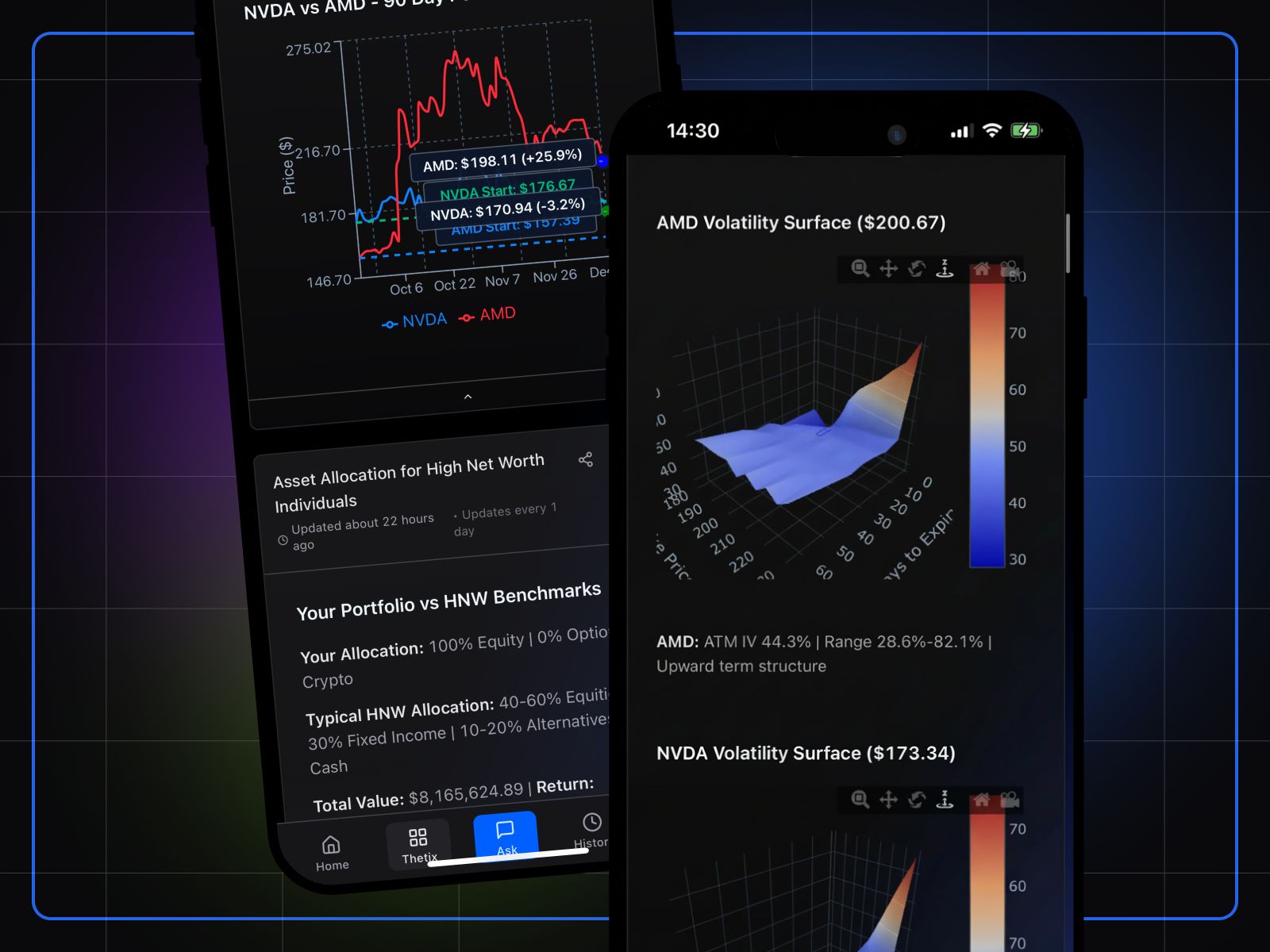
Navigating the challenges of dividend-related risks in options trading requires precision, especially when managing covered calls around ex-dividend dates. ThetaEdge provides traders with tools tailored to these needs. By connecting to over 80 brokerages through read-only access, the platform analyzes your actual holdings and highlights covered-call opportunities that align with the specific dividend schedules of your stocks.
For every trade, ThetaEdge offers detailed metrics, including "assignment risk" and "probability of assignment." These figures help you assess the likelihood of your shares being called away before or on an ex-dividend date. This clarity allows you to make informed choices - whether to focus on collecting dividends or to aim for higher option premiums.
The platform also simplifies portfolio management with its Thetix AI assistant. Thetix AI provides straightforward answers to portfolio-related queries. For instance, asking about "Apple dividend payout and history" delivers structured summaries of ex-dividend dates, dividend amounts, and historical data. In February 2026, Thetix AI reviewed Apple Inc. (AAPL) following its February 9 ex-dividend date, noting a $0.26 per share dividend. It also projected a 1-year price forecast of $667.79, reflecting a 5.8% increase from a starting price of $631.00. For a sample high-net-worth portfolio, the system identified 10 income opportunities, estimating an annual income of $22,091 (a 14.7% return) with an assignment risk occurring nine times per year.
ThetaEdge also allows users to set customizable alerts for price movements or volatility changes that could signal early exercise risks. As Maxim Khailo, ThetaEdge's Founder & CEO, explains:
"ThetaEdge analyzes your holdings and surfaces covered-call opportunities with clear risk, probability, and income metrics, so you can decide what's worth your attention".
The platform is free to get started, offering self-directed investors access to tools that blend dividend schedules, option pricing, and assignment risk into actionable insights. This approach makes managing the complexities of dividend-related options trading more practical and efficient.
Conclusion
Grasping how ex-dividend dates influence option pricing is crucial for anyone dealing with options on dividend-paying stocks. As the ex-dividend date approaches, call options typically lose value, while put options gain value due to the expected drop in the stock price after the dividend is paid.
This dynamic makes it important to closely monitor option premiums. Mike Scanlin, Founder of Born To Sell, emphasizes:
"Basically, if there is even 1 penny of time premium remaining in the option, the option holder is better off selling the option than exercising it".
When the remaining time premium dips below the dividend amount, the likelihood of assignment increases significantly.
A handy way to assess this is by checking put-call parity. If the corresponding put option is priced lower than the dividend, your in-the-money call option is likely a candidate for early exercise. This quick check can help you avoid surprise assignments and ensure you don’t miss out on dividend payments. Tools that simplify these calculations can make the process much easier.
By applying these strategies, platforms like ThetaEdge provide self-directed investors with advanced tools to navigate the complexities of dividend-option interactions, turning them into straightforward, actionable insights.
With the right knowledge and resources, you can effectively manage trading around ex-dividend dates, capturing both dividend income and option premiums while minimizing assignment risks.
FAQs
How can I tell if my covered call might be assigned before the ex-dividend date?
To estimate the chances of early assignment before the ex-dividend date, consider a few key factors. If the option is deep in-the-money, carries little to no time premium, or the stock is approaching a dividend payout, the risk of early exercise rises. Keeping an eye on these elements can help you better prepare for possible scenarios.
Why do put premiums often rise going into an ex-dividend date?
Put option premiums often rise as the ex-dividend date approaches. This happens because the stock price is expected to drop by the dividend amount on that day. Such a decline boosts the appeal of put options, as they gain value for investors anticipating a downward price shift.
When do exchanges adjust option strikes for special dividends?
When a company announces a special dividend after an option has been purchased, exchanges typically adjust the option's strike price on the ex-dividend date. This adjustment reduces the strike price by the dividend amount, aligning the option's value with the stock's adjusted price after the dividend is paid.