

Position Sizing Strategies for Risk Management
Learn practical position sizing methods: 1%-2% risk rules, volatility adjustments and options sizing to protect capital and manage drawdowns.
Position sizing is the cornerstone of risk management in trading. It determines how much of your account is at risk on any single trade, helping you protect your capital and stay in the game long-term. The key takeaway? Never risk more than 1%–2% of your account on a single trade. This ensures that even during a streak of losses, your account remains intact.
Here’s what you need to know:
- Why It Matters: Poor position sizing, not bad trades, is often why accounts blow up.
- Core Principle: Set your risk per trade (1%–2% of your account) before entering.
- Methods: Fixed percentage, fixed dollar amount, risk-based, and volatility-adjusted sizing.
- Risk Management: Predefined rules prevent emotional decisions during market swings.
- Options-Specific Tips: Size based on maximum loss, not premiums, and manage portfolio Greeks. For specific strategies, learn how to calculate risk for cash-secured puts to protect your capital.
The goal? Ensure no single trade can jeopardize your account. Stick to these principles, and you'll build discipline, manage losses, and create a trading plan that can weather any market.
Position Sizing Basics
What is Position Sizing?
Position sizing determines how many shares, units, or contracts you should trade based on your account size, risk tolerance, and stop-loss level. This is not guesswork - it’s a calculated decision. For instance, imagine you have a $25,000 account and plan to buy Apple Inc. at $160 per share, with a stop-loss set at $140. Here, the risk per share is $20. If you decide to limit your risk to 2% of your account ($500), you would purchase 25 shares ($500 ÷ $20).
This calculation is key to managing your exposure to the market. As Brijesh Bhatia, Equity Capital Market Analyst at Definedge, explains:
"Position sizing is the glue that holds together a sound trading system. It ensures you don't over-leverage or under-commit in any single trade, helping you stay in the game long enough to let your edge play out over a series of trades".
Next, we’ll see how position sizing ties directly into risk management.
Position Sizing and Risk Management
The core idea is simple: no single trade should jeopardize your account’s overall health, even if it ends in a loss. For example, if you risk 2% of your account per trade, 10 consecutive losing trades would still leave you with 80% of your account. If you risk 5%, you’d retain 60% after the same streak of losses.
Predefining your position size also helps you avoid emotional decision-making. During volatile market conditions, you’re less likely to adjust stop-losses impulsively or take reckless risks. This preset approach fosters emotional discipline and ensures that your trading decisions remain consistent, even when the market becomes unpredictable.
By sticking to this method, you develop a structured mindset that helps you handle market volatility and refine your strategies effectively.
Factors That Affect Position Size
To tailor your position sizes effectively, you need to understand the key factors involved. These include your account size, risk per trade, trade risk (the difference between your entry price and stop-loss), and market volatility.
For example, during high-volatility events like earnings announcements, it’s wise to cut your position size in half. This adjustment minimizes the impact of “gap risk,” where a stock opens significantly lower than its previous close, potentially triggering your stop-loss. Reducing your position size in such cases ensures your losses stay closer to your intended risk level.
Here’s a quick guide to risk levels and their suitability:
| Risk Level | Risk Per Trade | Best For |
|---|---|---|
| Conservative | 0.5% - 1.0% | New traders, larger accounts |
| Standard | 1.0% - 2.0% | Most active traders |
| Aggressive | 2.0% - 3.0% | Experienced traders, smaller accounts |
Source:
sbb-itb-a9ac3c2
Common Position Sizing Methods
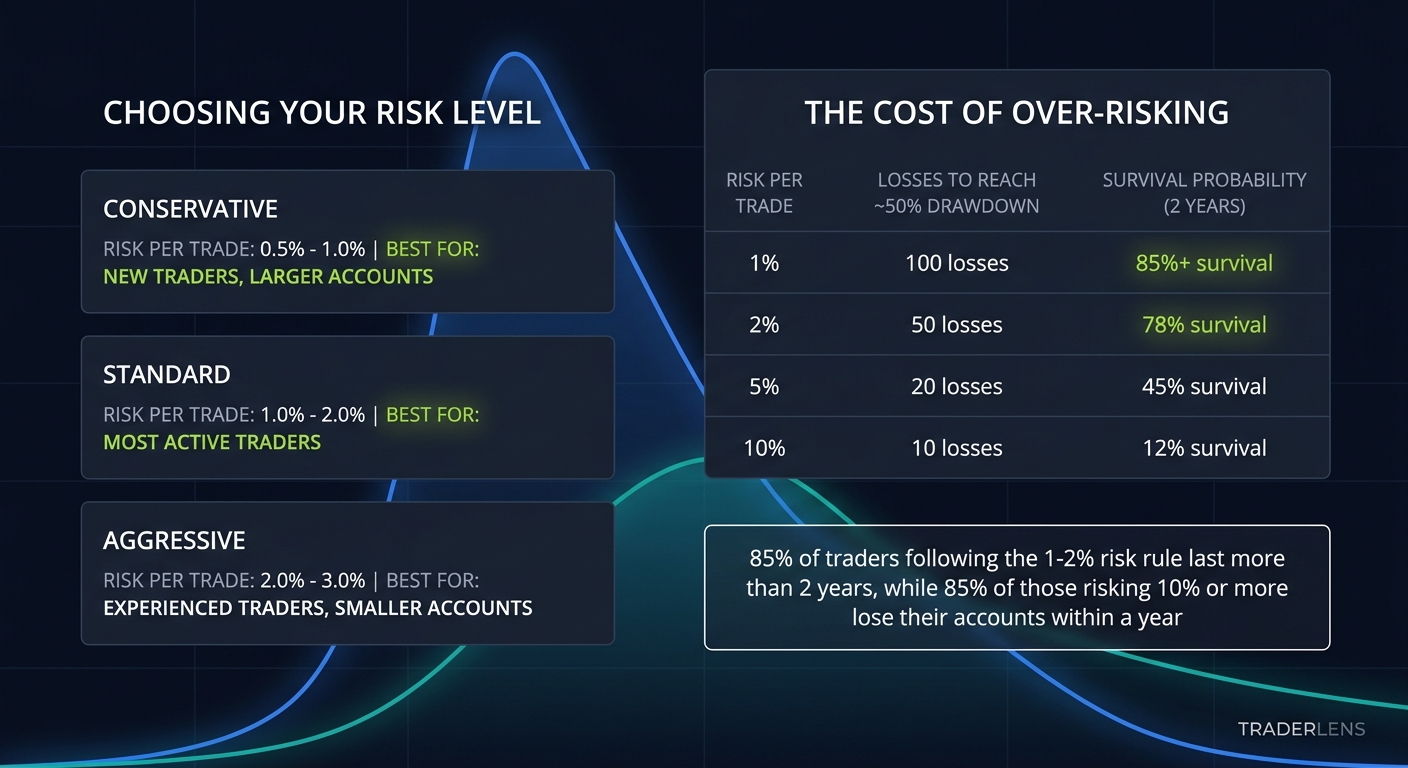
Position Sizing Risk Levels and Account Survival Rates for Traders
Here’s a look at four widely used position sizing approaches.
Fixed Percentage Method
This method involves allocating a fixed percentage of your portfolio to each trade. For instance, if your account totals $100,000 and you decide on a 10% allocation per trade, you'd invest $10,000 in each position. Its straightforward nature makes it appealing to beginners. However, this simplicity comes with a downside: it doesn’t account for the risk levels of individual trades. Applying the same percentage to a highly volatile stock could lead to larger-than-expected losses.
Fixed Dollar Amount Method
Under this method, you assign a set dollar amount to every trade - say $500 - regardless of your account size or the asset’s volatility. This approach is especially beginner-friendly. For example, in options trading, if each contract costs $2.50 (equivalent to a $250 premium per contract), you’d buy two contracts to stick to your $500 allocation. The drawback? It doesn’t scale with your account. If your portfolio grows from $10,000 to $50,000, you’re still risking $500 per trade, which becomes a smaller relative risk as your account grows - or a larger relative risk during a losing streak.
In contrast to this static approach, risk-based sizing adapts to the potential loss of each trade.
Risk-Based Position Sizing
This method prioritizes how much you’re willing to lose over how much capital you deploy. Typically, traders risk 1–2% of their account on any single trade. For example, with a $50,000 account and a 1.5% risk tolerance ($750), you might purchase NVIDIA shares at $400 each with a stop-loss set at $384, risking $16 per share. In this case, you could buy about 46 shares. As Investopedia explains:
"Position sizing is the process of determining how many units an investor or trader will invest in a specific security while accounting for the account size and risk tolerance".
TraderLens data highlights the importance of this approach: 85% of traders following the 1–2% risk rule last more than two years, while 85% of those risking 10% or more lose their accounts within a year.
Volatility-Adjusted Position Sizing
This more advanced strategy incorporates metrics like the Average True Range (ATR) to adjust position sizes based on market volatility. For example, with a $50,000 account and a 1.5% risk limit ($750), you might trade a $400 stock with an ATR of $8. Using a 2× ATR multiplier, your stop-loss distance would be $16, allowing for a purchase of about 46 shares. For a less volatile stock with an ATR of $4, the same $750 risk would permit about 93 shares. This method ensures that volatile assets don’t disproportionately affect your portfolio. It’s a way to fine-tune risk management in fluctuating markets, reinforcing the principle that no single trade should put your portfolio in jeopardy.
| Risk Per Trade | Losses to Reach ~50% Drawdown | Survival Probability (2 Years) |
|---|---|---|
| 1% | 100 | 85%+ |
| 2% | 50 | 78% |
| 5% | 20 | 45% |
| 10% | 10 | 12% |
Source: TraderLens
Building Position Sizing Into Your Trading Plan
Position sizing isn’t just a technical detail - it’s a cornerstone of a solid trading plan. Without clear guidelines, even the most effective strategies can crumble under the weight of emotional decision-making, especially during losing streaks or hot streaks.
Setting Risk Limits and Trade Rules
Start by defining how much of your account you’re willing to risk on each trade. Many professional traders stick to a 1% to 2% risk per trade rule. Once you’ve identified your stop-loss level using technical analysis, calculate your position size with this formula:
Shares = (Account Size × Risk %) / (Entry Price - Stop Price).
It’s also crucial to manage your overall portfolio risk. Set a portfolio heat limit - this is the total percentage of your account at risk across all open trades. A typical range is 6% to 10%, and no single position should account for more than 20% to 25% of your account. These rules work together to protect your portfolio from excessive exposure.
With these safeguards in place, you’ll be better equipped to handle shifting market conditions.
Adjusting for Market Changes
Markets aren’t static, and neither should your trading plan be. When volatility increases - like when the 14-day ATR exceeds its six-month median - many institutional traders reduce their risk per trade by 25% to 50%. Similarly, during earnings season, consider halving your position size to guard against the risk of price gaps that could bypass your stop-loss.
Another key adjustment involves setting drawdown triggers. For instance, if your account value drops by 5% from its peak, reduce your risk per trade by 25%. If losses deepen to a 10% to 15% drawdown, cut your risk by 50% and focus exclusively on your highest-probability setups. This ensures you’re taking on more risk when you’re performing well and scaling back when things aren’t going your way.
Consistently revisiting and refining your rules will help you stay aligned with your account’s changing dynamics.
Regular Review and Adjustment
Revisit your risk levels on a weekly basis to ensure they align with your current equity. For example, if your account grows from $50,000 to $55,000, your 1% risk per trade increases from $500 to $550. Conversely, if your account drops to $45,000, your risk should decrease to $450.
Keep an eye on correlated positions. For instance, holding three semiconductor stocks could expose you to concentrated sector risk, so treat them as a single position for risk management purposes. Legendary hedge fund manager Paul Tudor Jones offers a valuable perspective:
"I have a maximum drawdown of 10% before I get out of all my positions and go to cash".
Establish clear rules for when to pause trading, reduce position sizes, or reevaluate your overall strategy. These steps will help you maintain discipline and protect your account over the long term.
Common Position Sizing Errors to Avoid
Even the most well-planned strategies can fail if position sizing is mismanaged. The difference between traders who achieve long-term success and those who face significant losses often boils down to avoiding a few key mistakes.
Over-Leveraging and Emotional Trading
Using too much leverage amplifies losses and can lead to liquidation after even minor price swings. For instance, a 25% drawdown in an account requires a 33% gain just to break even.
Winning streaks can tempt traders to increase position sizes, breaking their own risk rules. Even more damaging is revenge trading - after a big loss, traders may take larger positions in an attempt to recover quickly, often depleting their accounts faster. As Pham The Anh explains:
"The difference between traders who survive long-term and those who blow up accounts isn't strategy quality - it's risk management precision".
One way to avoid this trap is to automate position sizing. Tools like position sizing calculators can help by basing trade sizes on your current equity and risk percentage, removing emotional decision-making. Setting a strict drawdown limit - such as pausing trading if your account drops by 15% - can also provide a buffer for reassessment.
The key is to remain consistent in applying your risk management rules, even when emotions run high.
Inconsistent Strategy Application
Straying from a defined strategy, such as risking 1% or 2% per trade, introduces emotional instability into your trading approach. On one day, you might risk just 1%, but on another, you might gamble 5%, leading to erratic outcomes. Van Tharp, founder of the Van Tharp Institute, highlights this:
"Even a holy grail system, you can blow up through improper position sizing, whereas even a weak system, you could conceivably achieve your objectives with excellent position sizing".
A study from 1991, which tracked 82 portfolio managers over a decade, found that position sizing was responsible for 91% of performance variability. The real challenge isn't figuring out the correct trade size - it’s sticking to it, especially when emotions try to take over.
Ignoring Volatility Differences
Overlooking volatility differences across assets can lead to uneven risk exposure. For example, using the same position size for a stable blue-chip stock and a highly volatile cryptocurrency means taking on vastly different risks. Someone risking 2% of their capital during a 20% market swing will fare far better than someone risking their entire capital in the same scenario.
Trading without a fixed stop-loss further complicates this issue, as it leaves your risk undefined and makes accurate position sizing nearly impossible. As TraderLion puts it:
"A stop converts risk from fuzzy to fixed. Without it you are blind".
To address this, tools like the Average True Range (ATR) can help measure an asset's volatility. For more volatile instruments, reduce your position size accordingly. During periods of heightened volatility - such as before earnings announcements - consider cutting your position size in half to protect against gap risks, where prices may jump past your stop-loss.
Adjusting for volatility ensures that your risk management strategies remain effective, no matter the market conditions.
Position Sizing for Options Strategies
Options trading brings its own set of challenges, including unique risk profiles and time decay. While position sizing is a key part of any trading strategy, options require extra care due to their leverage and time-sensitive nature. Whether you're working with covered calls or iron condors, properly allocating capital and managing exposure can mean the difference between generating steady income and facing margin calls.
Allocating Capital Across Multiple Strategies
A critical rule of thumb: size your positions based on the maximum potential loss, not the premium collected. For example, selling an iron condor for $100 may seem like a $100 risk, but if the maximum loss is $900, that’s the figure to use when calculating position size. Misjudging risk by focusing on the premium can lead to unpleasant surprises if the market moves against you.
Professional traders often limit risk per trade to 1% to 5% of their total account value, depending on the strategy and its likelihood of success. For strategies like iron condors or credit spreads, which have higher probabilities of success, a 3% to 5% risk allocation is common. On the other hand, directional trades like long calls or puts, which carry lower win rates, are typically capped at 1% to 2%. Speculative plays, such as earnings trades, are often sized at just 0.5% to 1% of the account.
Here’s an example of how a balanced portfolio might allocate capital:
| Allocation | Strategy Category | Examples |
|---|---|---|
| 40–50% | Stable Income | Covered Calls, Wheel Strategy, PMCCs |
| 30–40% | Defined Risk | Credit Spreads, Iron Condors |
| 10–20% | Tactical/Speculative | Earnings Plays, Straddles, Long Options |
To avoid overexposure, it’s wise to keep the total capital at risk - your portfolio "heat" - between 30% and 50% of your account value. Many traders maintain 50% to 70% of their account in cash or short-term treasuries. This cash reserve acts as a safety net, helping to meet margin requirements or adjust positions during volatile market conditions.
Diversification is key. Limit yourself to two or three positions per sector to avoid turning your portfolio into a single large bet during sector-wide selloffs. Once capital allocation is in place, use portfolio Greeks to refine your risk management.
Using Portfolio Greeks for Position Sizing
Analyzing individual trades is essential, but it doesn’t always reveal the bigger picture. Combining multiple positions can expose portfolio-level risks that aren't immediately obvious.
- Delta measures directional exposure. A portfolio delta of +500 is similar to owning 500 shares of stock. Many income-focused traders aim for a delta between 0 and +30 per $100,000 of capital, maintaining a neutral or slightly bullish stance.
- Gamma reflects how quickly delta changes with price movement. High gamma can lead to large swings in your portfolio’s profit and loss. Professionals often keep gamma between –100 and 0 to avoid excessive volatility.
- Theta represents daily time decay. Positive theta, ideally between +$50 and +$150 per day per $100,000 of capital, ensures steady income from premium erosion.
- Vega gauges sensitivity to changes in volatility. Maintaining vega between –50 and +50 helps keep your portfolio stable during volatility spikes.
- Beta-weighting translates all positions into "SPY equivalents", providing insight into how a 1% move in the S&P 500 might affect your portfolio. This helps manage hidden correlations.
To size positions using Greeks, use this formula:
Position Size (contracts) = (Account Value × Risk %) / Max Loss Per Contract.
For example, with a $100,000 account, a 3% risk tolerance, and a $300 maximum loss per iron condor contract:
($100,000 × 0.03) / $300 = 10 contracts.
Platforms like ThetaEdge simplify portfolio-level Greek analysis, letting you monitor aggregate risks without manual calculations. This approach ensures that adding a new trade doesn’t push your delta or gamma beyond safe levels.
Scaling Into Positions
Position sizing is just one part of the equation. Timing your entries can also improve risk control, especially with multi-leg strategies influenced by volatility and timing.
The 21 DTE rule is a common practice: close or roll positions with 21 days to expiration. This reduces exposure to the high gamma risk that often appears in the final weeks of an option’s life. By exiting early, you can avoid turning a small adverse move into a maximum loss.
For profit-taking, many traders use a staggered approach. For example, they might close half of a position at 50% of its maximum profit and the rest at 75%. This locks in gains while still allowing the trade to reach its potential. Some professionals close trades at 25% or 50% of maximum profit to reduce exposure to unexpected events, such as "Black Swan" market moves.
Mechanical stops are another tool for managing risk. For high-probability trades, setting a stop-loss at twice the premium collected - exiting if a $100 trade loses $200 - helps protect capital. As ImpliedOptions Research explains:
"Risk management isn't about avoiding losses; it's about ensuring that no single loss can significantly impair your ability to trade the next day".
Guardrails like drawdown limits are also essential. If your account equity falls 10% to 12% from its peak, consider scaling back position sizes or pausing new trades until your portfolio stabilizes. This prevents emotional decision-making during downturns.
During periods of high volatility, such as when the VIX spikes, it’s wise to reduce position sizes. While premiums may look more tempting, larger price swings increase gamma risk, making trades more vulnerable to maximum losses. A position that seems safe with a VIX at 15 could become risky at a VIX of 30.
Andrew Crowder, a seasoned options trader, emphasizes the importance of disciplined sizing:
"Position sizing is the hidden edge. It transforms good strategies into sustainable businesses and prevents bad streaks from ending your career".
Conclusion
Position sizing is the backbone of lasting success in the markets. Whether you stick with the Fixed Percentage Method, risking 2% per trade, or adjust based on volatility using ATR, the core idea stays the same: protect your capital first, focus on profits second.
One oversized position can undo months of careful gains, emphasizing the importance of sizing positions based on potential loss rather than the premium collected. As ImpliedOptions Research states:
"Proper position sizing is the single most important factor in long-term trading survival".
This concept is especially crucial in options trading, where leverage can amplify risks dramatically. A single day could bring losses ranging from 20% to 50%. To counteract this, experienced traders often keep 50% to 70% of their accounts in cash reserves and limit their overall portfolio risk - referred to as "heat" - to just 30% to 50% of their capital. Their main priority is preserving capital to withstand inevitable drawdowns, rather than chasing every possible profit.
The strategies outlined in this guide, from the 1% to 5% risk rule to managing portfolio Greeks, all aim to achieve one critical goal: ensuring that no single trade can jeopardize your trading career. A written plan with clear, predefined risk limits takes emotion out of the equation, transforming position sizing into an objective, repeatable process. You can further refine this process by using AI-powered portfolio analysis to identify risks in plain English. This disciplined approach acts as a safeguard, allowing you to navigate all market conditions with confidence.
FAQs
How do I choose between 1% and 2% risk per trade?
When deciding between risking 1% or 2% of your capital per trade, the right choice depends on your personal approach and financial goals. Opting for 1% risk is a safer route, offering better protection for your capital during losing streaks. On the other hand, 2% risk can lead to larger positions and potentially higher returns, though it also means losses will have a bigger effect on your account. Your decision should reflect your trading experience, objectives, and overall risk management strategy for consistent results.
What should I do if a stock can gap past my stop-loss?
If a stock has the potential to gap beyond your stop-loss, it might be worth exploring a time stop or tweaking your stop-loss strategy to better handle gaps and market swings. Options like mental stops or trailing stops can offer more adaptability, helping to limit losses if the stock behaves unpredictably. These methods often provide greater flexibility compared to sticking strictly to a fixed price level for managing risk.
How do I size options trades using max loss and portfolio Greeks?
To figure out the right size for your options trades, start by deciding your maximum acceptable loss per trade - often between 1% and 5% of your total portfolio. Once you’ve set that limit, calculate your position size by dividing this amount by the maximum potential loss per contract.
Beyond sizing individual trades, keep an eye on your portfolio Greeks - metrics like delta, theta, and vega. These help you understand your overall risk exposure and prevent unexpected imbalances. By combining disciplined trade sizing with Greek monitoring, you can maintain a balanced portfolio and safeguard your capital over time.